Emotional Landscaping for Leaders
The Emotional Landscape
The emotional landscape forms the bedrock on which business is done. It’s made up of all the behaviours, relationships, interactions, beliefs, the feelings and actions of the people who work in the business.
Most things we do in our business are anchored in emotions. Around 70 to 90% of our decisions are influenced by our emotions.
Leaders’ behaviours have the most significant influence. What people experience and how people feel, impacts their ability to share in purpose, follow direction and strategy, and collaborate on priorities. About 80% of what counts in leading people is based on emotional intelligence.
The emotional landscape is still pretty much uncharted territory for most leadership teams, yet it holds huge potential for improving a business. It is the source of many of the emotional pressures felt by leaders – such as over-work, failure to confront difficulties effectively, fear, lack of joy in work, feeling isolated, imposter syndrome ,lower standards of self-care, lack of warmth, kindness and connection. And for some burnout or even breakdown.
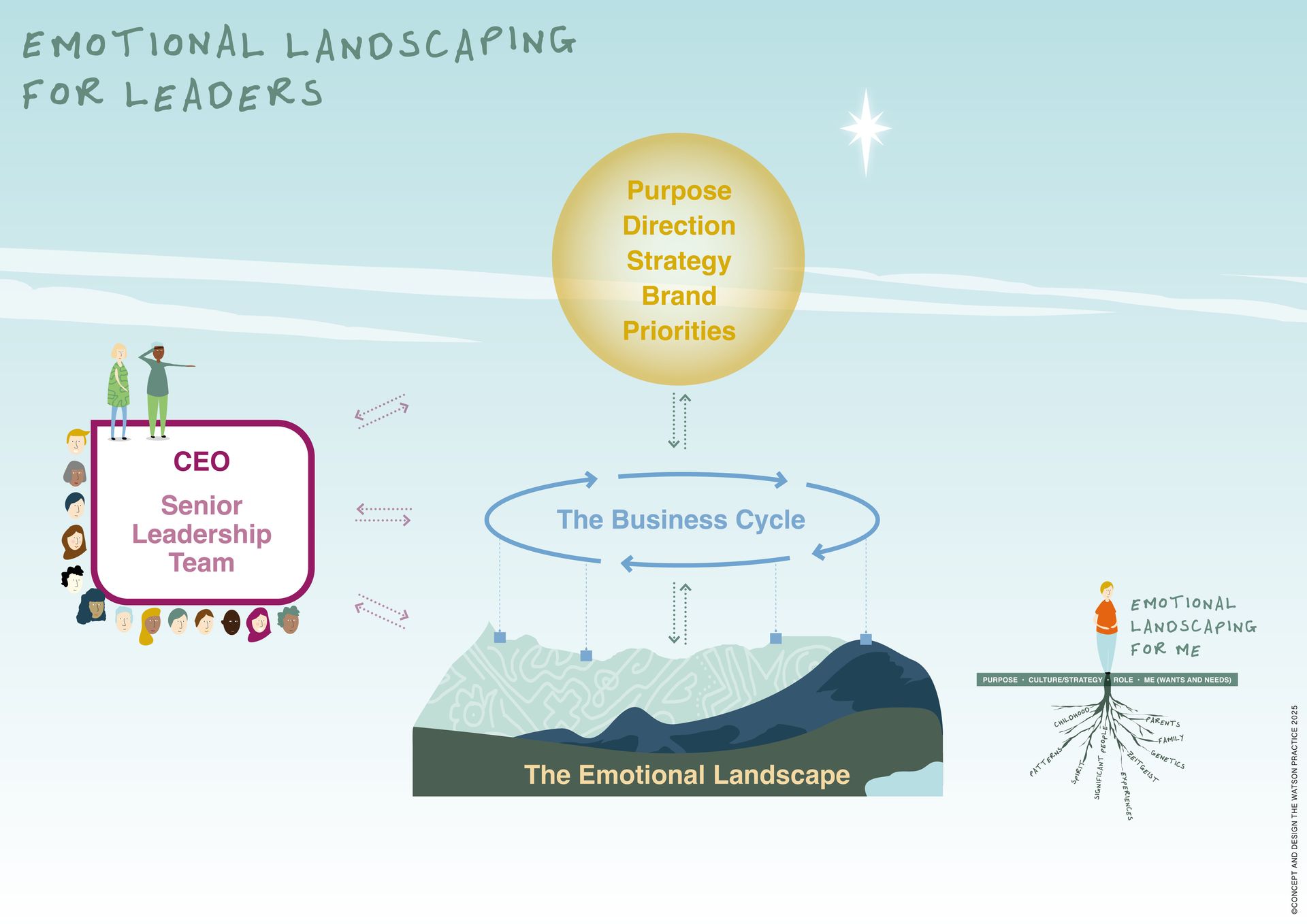
You can think of it like this. The bedrock of the business is the emotional landscape, on top of that we sit the business cycle – how the business works, how it all fits together, the systems and processes, the drivers and levers we can pull to change our business.
Then guiding all that, the purpose, direction, strategy, and priorities.
The modern leadership team orchestrates all this across and through the business with much less top down.
Emotional landscaping can provide the architecture for improving the situation and realising significant business and personal benefits – one of my roles is to guide leaders through their landscape, discovering what is really happening, talking things through with other leaders and choosing options to make things better.
I also see leaders working on their personal emotional landscape, taking a deeper look at themselves and choosing their options to explore their potential and grow.
This is beyond strategy, beyond processes and systems (all of which are vital) it’s taking a look into the emotional landscape and being able to recognise what we have. Because if we don’t do the emotional landscaping well … it’s going to impact our business cycle and keep interfering with it.
People have been wrestling with culture for years. It’s kind of crazy that people have built massively detailed and complex models and processes to assess culture and decide what culture we want, what the values should be and how to get people to buy in and adopt. Candid feedback from most leaders will reveal that these approaches are seen as tedious with little or no effect on the business.
What will change the business for leaders is learning in greater depth about their personal impact, about their own emotional intelligence particularly self-awareness and empathy – how to build better relationships, really listen to others and respond well to feedback. Learning to communicate better with people and tell stories in ways that engage and inspire.
Explore your landscape
Businesses are made up of people and their evolving lives. The emotional landscape is a real and living part of a business, it’s for ever changing and requires continuous attention. It can never be perfect or be measured through machine like measures. We know when it feels right and we sense when things are disrupted and disturbed. Emotional landscaping helps business leaders learn how to take more control and create more stability.
When we start to work with a client on their emotional landscape, we use a straightforward approach spread over 4 simple steps.
These steps are customisable; this gives you the idea.
1. Context and scope –Introductory presentation and conversations with the leadership team
2. The current situation – considering through the individual perspectives of the leadership team. A one-to-one session with each team member. And a group of next tier leaders. A summary of the output circulated to the team – for comment and discussion
3. Leadership team meeting to discuss and plot out how they see the business’ emotional landscape – what we have and what we’d like to create. (Custom made conversation materials, developed in collaboration with some of the team, are used to facilitate the conversations)
4. Designing and developing the approach to emotional landscaping for now and ongoing – specific to your business.
Curious about exploring your emotional landscape (business and personal)?
Explore the emotional landscape on which business is done and teams are built